HSF-India/ePIC Workshop

Asia/Kolkata
Seminar Room (Van Vihar Guesthouse)

Seminar Room

Van Vihar Guesthouse

Beside Gulmohar Restaurant, IIT Bombay, Powai, Mumbai, Maharashtra 400076 INDIA
Description

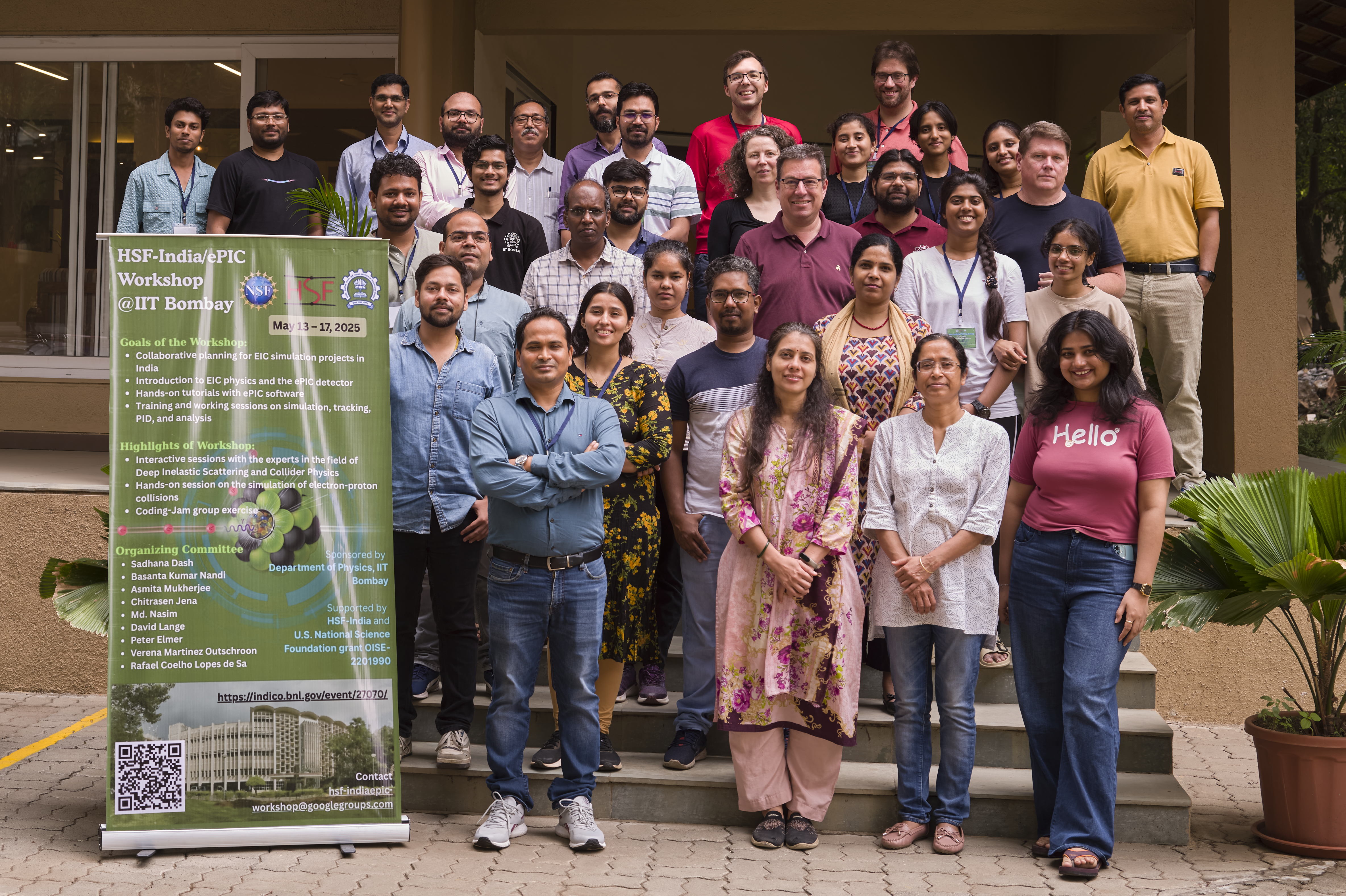
Welcome to the HSF-India/ePIC Workshop!

(Click for full resolution photo.)

The goals of this event include:

  • Workshop to discuss interests and plans for projects on simulation for EIC in India
  • Introduction to EIC/ePIC physics and detector
  • Tutorial on ePIC software
  • Dedicated training and time to work on topics in detector simulation, tracking, Particle identification (PID), analysis, etc

This event is intended to be helpful for early career members of the EIC community and those interested in getting involved to learn about the steps to become productive and to participate in open projects. It is also intended to help faculty and scientists to learn about ongoing activities and contribute to several areas in simulation.ย 

This event is sponsored by HSF-India. People are the key to successful software. The HSF-India project aims to promote the development of international research software collaborations. This is the sixth in a series of workshops for software and data analysis skills essential for doing research software in physics.ย 

A set of pre-workshop lectures covering some of the prerequisite materials for this workshop are planned, more details are forthcoming. These will be mandatory for students not already familiar with the material to ensure that everyone is prepared for the workshop (additional information to be provided after registration).ย 

This event is supported by the Department of Physics, IIT Bombay and the U.S. National Science Foundation grant OISE-2201990.
ย  ย ย ย ย 

    • 1
    • 2
      Welcome and Introduction
    • 10:45
      Tea
    • Introductory EIC Talk
      • 3
        The Electron-Ion Collider

        An introduction to the EIC and the science it will enable.

        Speaker: Charlotte Van Hulse
    • HSF-India and Research Software Collaboration
    • 13:00
      Lunch
    • HSF-India and Research Software Collaboration
    • ePIC - Getting Involved

      How you can get involved with ePIC software development, open topics.

      • 7
        Contributing to ePIC - Open Topics

        An introduction and overview of the major areas where you can contribute to ePIC software development and physics analyses.

        Speaker: Dr Markus Diefenthaler (Jefferson Lab)
      • 8
        Contributing to ePIC - How to get involved

        An overview and introduction to how you can contribute to the ePIC software and physics effort.

    • 16:00
      Tea
    • HEP Software and Tutorial Setup
      • 9
        HEP Software and Data Analysis

        What sort of data do we get from HEP experiments? How do we typically analyse it?

        Speaker: Stephen Kay (University of York)
      • 10
        Hands on - Tutorial Startup

        Getting started with the tutorial environment, how we will be running things and what we can (and cannot!) do with the software on hand.

        Speaker: Stephen Kay (University of York)
    • 11
      Social Dinner
    • ePIC Tutorials - Session 1
      • 12
        ePIC Software

        A recap of the different scenarios in which we may utilise EIC software. An introduction to the ePIC software stack. What is available? How can we utilise each individual component.

        Speaker: Stephen Kay (University of York)
      • 13
        Tutorial - Exploring the Available Files

        How we can access simulation campaign output? What information is contained within the different files? How can we begin accessing and using this information using uproot?

        Speaker: Stephen Kay (University of York)
    • 10:30
      Tea
    • Social Activity/Challenge
      • 14
        Social Activity/Challenge

        A group activity to get to know your colleagues from across India.

    • 15
      Tutorial Session - Uproot and Accessing Data

      A short tutorial session to end the day, a quick look at the python Uproot package that we will be using extensively going forward.

      What is a root file? What is uproot? What can we do with our files?

      Homework assignment to try after the session.

      Speaker: Stephen Kay (University of York)
    • 13:00
      Lunch
    • 16
      Tutorial Session - Uproot and Accessing Data

      A short tutorial session to end the day, a quick look at the python Uproot package that we will be using extensively going forward.

      What is a root file? What is uproot? What can we do with our files?

      Homework assignment to try after the session.

      Speaker: Stephen Kay (University of York)
    • HEP Software and Tutorial Setup
      • 17
        The ePIC Detector

        An introduction to the various subsystems of the ePIC detector. What each subseciton can be utilised for and what sort of information we can expect to get from each subsystem.

        How can we use this information to identify the things we're interested in?

        Speaker: Charlotte Van Hulse
    • 15:45
      Tea
    • ePIC Tutorials - Session 1
      • 18
        Tutorial - Working with Simulation Output

        A tutorial on what is included in the output of EICrecon.

        Working with files we got in the morning, a deeper dive into what is there. What we can do with these files and what information we can get.

        Visualising events.

        Homework task.

        Speaker: Stephen Kay (University of York)
    • 19
      Tutorial - Working with Simulation Output

      A continuation of the session from Wednesday

      Speaker: Stephen Kay (University of York)
    • ePIC Tutorials - Session 2
      • 20
        Introduction to Particle Identification and RICH

        What is the operating principle of the detectors used in ePIC? What sort of information do they provide and how can we utilise that?

        Speaker: Chandradoy Chatterjee (INFN Trieste (IT))
      • 11:00
        Tea
      • 21
        Introduction to Particle Identification and RICH

        How did we arrive at the quantities we looked at yesterday?

        How were our particles reconstructed? How do we use the information available to conduct particle identification?

        Speaker: Chandradoy Chatterjee (INFN Trieste (IT))
    • 13:00
      Lunch
    • ePIC Tutorials - Session 3
      • 22
        Tutorial - Simulated Detectors

        Continuation of the morning session.

        Speaker: Chandradoy Chatterjee (INFN Trieste (IT))
      • 15:30
        Tea
      • 23
        Tutorial - Using Particle ID

        A tutorial on utilising what we've learned about Particle ID and reconstruction to select out events we want from the data.

        Homework task.

        Speaker: Chandradoy Chatterjee (INFN Trieste (IT))
    • ePIC Tutorials - Session 4
      Convener: Charlotte Van Hulse
      • 24
        Using Particle ID

        Continuation of the session from Thursday.

        Speakers: Chandradoy Chatterjee (INFN Trieste (IT)), Chandradoy Chatterjee (INFN Trieste)
      • 10:00
        Tea
      • 25
        Physics Analysis

        How do we combine what we've learned to actually conduct a physics analysis?

        What do we mean by an "analysis"? What sort of things do we need to consider?

        Speaker: Charlotte Van Hulse
      • 26
        Tutorial - Physics Analysis

        A tutorial on building up a physics analysis. How do we incorporate some of the things we discussed in the opening session today?

        Speaker: Charlotte Van Hulse
    • 13:00
      Lunch
    • ePIC Tutorials - Session 5
      • 27
        Tutorial - Physics Analysis

        A continuation of the morning session.

        Speaker: Charlotte Van Hulse
    • 15:30
      Tea
    • Coding Jam Group Exercises: Introduction to projects and organization of groups

      Continuation of the morning tutorial, build up your physics analysis scripts.

      Convener: Charlotte Van Hulse
    • Coding Jam Group Exercises: Group Work

      Continuation of the morning tutorial, build up your physics analysis scripts.

      Convener: Charlotte Van Hulse
    • 28
      Coding Jam - Group work
    • 11:00
      Tea
    • ePIC Tutorial - Getting Involved, simulating your own data
      • 29
        ePIC Tutorial - Running Simulations

        An introduction to running your own physics simulation with the ePIC software stack.

        Speaker: Stephen Kay (University of York)
    • 13:00
      Lunch
    • Coding Jam Group Exercises: Group Work Reports

      Continuation of the morning tutorial, build up your physics analysis scripts.

    • 30
      Closeout
      Speaker: Rafael Coelho Lopes de Sa (University of Massachusetts Amherst)