***ATTENTION Indico Users***

Notice: LaTeX services are temporarily disabled and will be reintroduced in 3.3.12 which is currently being planned

Please see the News section for more information.

July 2026 Joint ePIC/EICUG Meeting

Europe/London
Glasgow

Glasgow

Daria Sokhan (CEA Saclay), Gary Penman (University of Glasgow), Rachel Montgomery, Stephen Kay (University of York)
Description

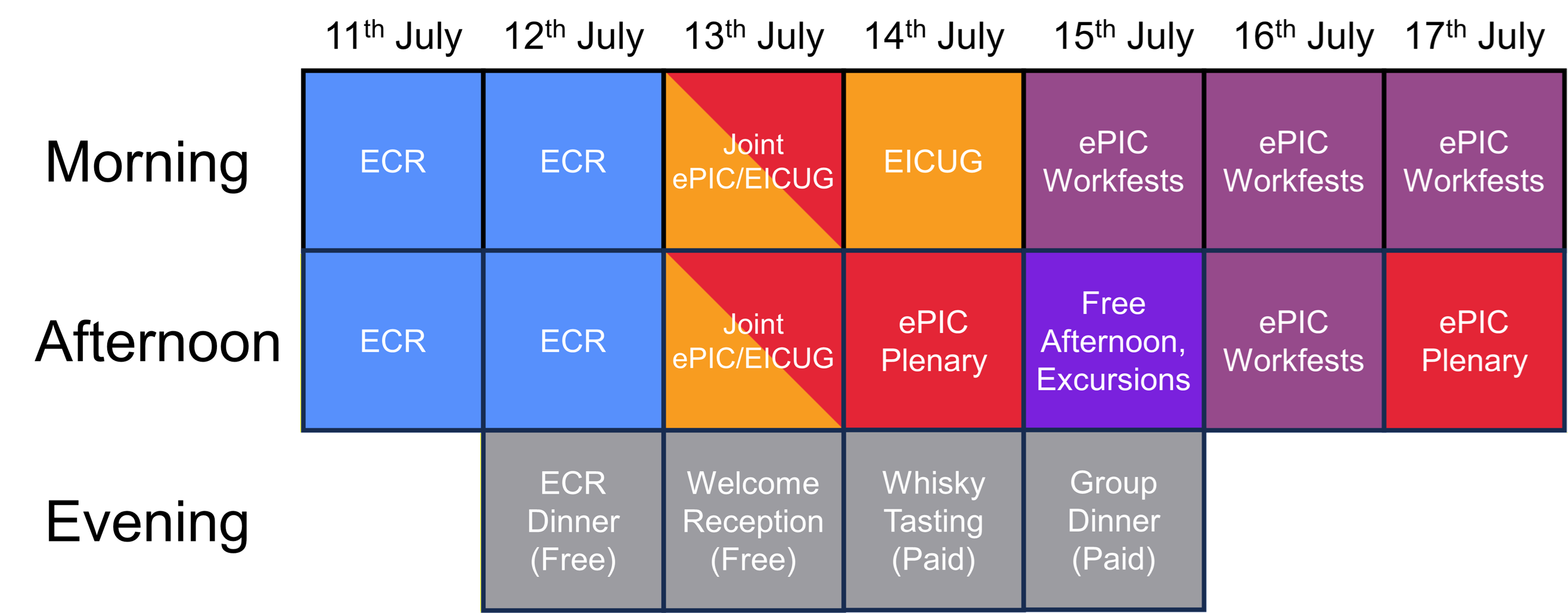
Welcome to the July 2026 Joint ePIC/EICUG Meeting!

For remote connections, please see the Zoom Connection Info Page.

The EICUG Early Career Researcher (ECR) meeting will be held on the 11th and 12th of July as part of this meeting. See the ECR indico for details -

https://indico.jlab.org/event/1067/

Please register separately for the ECR meeting via the form on the ECR event page when it is available.


The ePIC and EICUG meeting follow from the 13th to 17th of July.

Registration and fee payment are now available.

Please see the Fee Payment Page for further details.

We are grateful to the UK Institute of Physics (IOP) and the UK Science and Technology Facilities Council (STFC) for their sponsorship and financial support of this event.

Registration
Registration
Participants
    • 1
      Registration Sir Charles Wilson Building

      Sir Charles Wilson Building

    • Monday Plenary - Morning: Joint EICUG/ePIC Session 1 Sir Charles Wilson Building

      Sir Charles Wilson Building

      https://york-ac-uk.zoom.us/j/91762520178 Meeting ID: 917 6252 0178

      Passcode = PDG code of proton

      Conveners: Anselm Vossen (member@duke.edu;faculty@duke.edu), John Lajoie (Oak Ridge National Laboratory)
      • 2
        University of Glasgow Welcome from the Vice Principal and Head of College for Science and Engineering
        Speaker: Prof. Eric Yeatmen (University of Glasgow)
      • 3
        Local Welcome and Logistics
      • 4
        EIC Users Group Status
        Speakers: Anselm Vossen (member@duke.edu;faculty@duke.edu), Douglas Higinbotham (Jefferson Lab), Or Hen (MIT)
      • 5
        EICUG/ePIC Outreach
        Speakers: Dr E. C. Aschenauer (BNL), Marta Ruspa (University of Eastern Piedmont and INFN Torino)
      • 10:30
        Coffee Break
      • 6
        Early Science Whitepaper Report
        Speakers: Rachel Montgomery, Salvatore Fazio (University of Calabria and INFN-Cosenza)
      • 7
        The EPIOS Consortium
        Speaker: Dr Zein-Eddine Meziani (Argonne National Laboratory)
      • 8
        The AI Revolution and Nuclear Physics
        Speaker: David Lawrence (Jefferson Lab)
    • 12:30
      Lunch Sir Charles Wilson Building

      Sir Charles Wilson Building

    • Monday Plenary - Afternoon: Joint EICUG/ePIC Session 2 Sir Charles Wilson Building

      Sir Charles Wilson Building

      https://york-ac-uk.zoom.us/j/91762520178 Meeting ID: 917 6252 0178

      Passcode = PDG code of proton

      Conveners: Anselm Vossen (member@duke.edu;faculty@duke.edu), Silvia Dalla Torre (INFN, Trieste)
      • 9
        DOE Status
        Speaker: Paul Mantica (DOE HENP)
      • 10
        EIC Project Status
        Speaker: Jim Yeck
      • 11
        EIC Project Detector Status
        Speakers: Dr E. C. Aschenauer (BNL), Rolf Ent (Jefferson Lab)
      • 15:00
        Coffee Break
      • 12
        EIC Collider Status
        Speaker: Sergei Nagaitsev
      • 13
        Connecting the Dots: Polarimetry from the BNL Booster to the EIC
        Speaker: Evgeny Shulga (BNL)
      • 14
        Detector-II Summary Report
        Speaker: Cheuk-Ping Wong (Brookhaven National Laboratory)
    • Welcome Reception Glasgow City Chambers

      Glasgow City Chambers

      82 George Square, Glasgow G2 1DU, United Kingdom

      Please see instructions here - https://indico.bnl.gov/event/31808/page/737-welcome-reception - for how to get to the reception venue.

    • Tuesday Plenary - Morning: EICUG Sir Charles Wilson Building

      Sir Charles Wilson Building

      https://york-ac-uk.zoom.us/j/94833986033 Meeting ID: 948 3398 6033

      Passcode = PDG code of proton

      Conveners: Anselm Vossen (member@duke.edu;faculty@duke.edu), Charlotte Van Hulse
      • 15
        Summary of Early Career Workshop
      • 16
        Award Ceremony
      • 17
        Talks by Awardees
      • 10:30
        Coffee Break
      • 18
        Elections Committee Report
        Speaker: Nicola Rubini (University and INFN of Bologna, CERN)
      • 19
        AI4EIC Report
        Speaker: Cristiano Fanelli (W&M)
      • 20
        2nd Detector WG Report
        Speaker: Pawel Nadel-Turonski (CFNS Stony Brook University)
      • 21
        ePIC: Physics Analysis Coordination Status and Priorities
        Speakers: Rachel Montgomery, Salvatore Fazio (University of Calabria and INFN-Cosenza)
      • 22
        Discussion
    • 12:40
      Lunch Sir Charles Wilson Building

      Sir Charles Wilson Building

    • Tuesday Plenary - Afternoon: ePIC Plenary Session 1 Sir Charles Wilson Building

      Sir Charles Wilson Building

      https://york-ac-uk.zoom.us/j/94833986033 Meeting ID: 948 3398 6033

      Passcode = PDG code of proton

      Conveners: John Lajoie (Oak Ridge National Laboratory), Silvia Dalla Torre (INFN, Trieste)
      • 23
        Technical Coordination Status and Priorities
        Speaker: Silvia Dalla Torre (INFN, Trieste)
      • 24
        Discussion
      • 25
        Software and Computing Status and Priorities
        Speaker: Dr Markus Diefenthaler (Jefferson Lab)
      • 26
        Discussion
      • 15:40
        Coffee Break
      • 27
        New Monte Carlo samples for inclusive QCD final states
        Speaker: Frank Krauss (Durham)
      • 28
        Validating new samples with old data and new analyses
        Speaker: Andy Buckley (member@gla.ac.uk;staff@gla.ac.uk)
      • 29
        Professional Conduct and Collaboration Culture Training
        Speakers: Francesco Bossu (CEA-Saclay), Susanna Costanza (University of Pavia)
    • Electronics, Readout and DAQ and Streaming Computing WG Joint Workfest Session 1 Room 225 (Humanities LT) (Gilbert Scott Building)

      Room 225 (Humanities LT)

      Gilbert Scott Building

      https://york-ac-uk.zoom.us/j/95544495110 Meeting ID: 955 4449 5110

      Passcode = PDG cod of proton

      Conveners: David Abbott (Jefferson Lab), Fernando Barbosa (JLab), Jeff Landgraf (Brookhaven National Laboratory), Marco Battaglieri (Jefferson Lab), Dr Markus Diefenthaler (Jefferson Lab), Taku Gunji (Quark-Nuclear Science Institute, the University of Tokyo), Torre Wenaus (BNL)
      • 30
        Introduction & Streaming DAQ: Overview, Requirements and Timeline Room 225 (Humanities LT)

        Room 225 (Humanities LT)

        Gilbert Scott Building

        Speaker: Jeff Landgraf (Brookhaven National Laboratory)
      • 31
        Echelon 0 - Echelon 1 Interface, Status and Open Questions (Discussion) Room 225 (Humanities LT)

        Room 225 (Humanities LT)

        Gilbert Scott Building

        Speakers: Jeff Landgraf (Brookhaven National Laboratory), Marco Battaglieri (Jefferson Lab), Dr Markus Diefenthaler (Jefferson Lab), Taku Gunji (Center for Nuclear Study, the University of Tokyo), Taku Gunji (Quark-Nuclear Science Institute, the University of Tokyo)
      • 32
        Echelon 2 Participation Model (and Discussion) Room 225 (Humanities LT)

        Room 225 (Humanities LT)

        Gilbert Scott Building

        Speaker: Dr Markus Diefenthaler (Jefferson Lab)
      • 33
        Coffee Break 1A The Square

        1A The Square

        Gilbert Scott Building

      • 34
        NP-HPDF Project Room 225 (Humanities LT)

        Room 225 (Humanities LT)

        Gilbert Scott Building

        Speakers: Dr Markus Diefenthaler (Jefferson Lab), Torri Jeske (Jefferson Lab)
      • 35
        Streaming Readout Background Suppression Room 225 (Humanities LT)

        Room 225 (Humanities LT)

        Gilbert Scott Building

        Speaker: Dmitry Romanov (Jefferson lab)
      • 36
        BNL Orchestration Testbed Room 225 (Humanities LT)

        Room 225 (Humanities LT)

        Gilbert Scott Building

        Speaker: Dmitrii Kalinkin (Brookhaven National Laboratory)
      • 37
        Streaming Reconstruction Room 225 (Humanities LT)

        Room 225 (Humanities LT)

        Gilbert Scott Building

        Speaker: Takuya Kumaoka
    • Exclusive, Diffraction and Tagging PWG Lecture Theatre 466 (Gilbert Scott Building)

      Lecture Theatre 466

      Gilbert Scott Building

      https://york-ac-uk.zoom.us/j/96891363582 Meeting ID: 968 9136 3582

      Passcode = PDG code of proton

      Conveners: Garth Huber (University of Regina), Stephen Kay (University of York), Zhoudunming Tu (BNL)
      • 38
        EDT NIM Paper Updates - Latest Status 466

        466

        Gilbert Scott Building

        Speaker: Zhoudunming Tu (BNL)
      • 39
        Muon Identification in the ePIC Detector Using the XGBoost Toolkit Lecture Theatre 466

        Lecture Theatre 466

        Gilbert Scott Building

        Speaker: Maciej Blaut
      • 40
        Exclusive Production of Electron and Muon Pairs in Electron-Proton Collisions with the ePIC Detector Lecture Theatre 466

        Lecture Theatre 466

        Gilbert Scott Building

        Speaker: Mr Kacper Kopeć (AGH University of Krakow)
      • 41
        Exclusive Production of Tau Lepton Pairs in Electron-Proton Collisions with the ePIC Detector Lecture Theatre 466

        Lecture Theatre 466

        Gilbert Scott Building

        Speaker: Karol Ożóg
      • 42
        DVCS Analysis - Latest Progress Lecture Theatre 466

        Lecture Theatre 466

        Gilbert Scott Building

        Speaker: Oliver Jevons (staff@gla.ac.uk;member@gla.ac.uk)
      • 43
        eD TDIS - Latest Progress Lecture Theatre 466

        Lecture Theatre 466

        Gilbert Scott Building

        Speaker: Jan Vanek (University of New Hampshire)
      • 10:25
        Coffee Break 1A The Square (Gilbert Scott Building)

        1A The Square

        Gilbert Scott Building

      • 44
        Diffractive DIS - Latest Progress Lecture Theatre 466

        Lecture Theatre 466

        Gilbert Scott Building

        Speaker: Arjun Kumar (CFNS, Stony Brook University)
      • 45
        eA Phi - Latest Progress Lecture Theatre 466

        Lecture Theatre 466

        Gilbert Scott Building

        Speaker: Maci Kesler (Kent State University)
      • 46
        DVMP J/Psi - Latest Progress Lecture Theatre 466

        Lecture Theatre 466

        Gilbert Scott Building

        Speaker: Mr Olaiya Olokunboyo (UNH)
      • 47
        Kaon SF - Latest Progress Lecture Theatre 466

        Lecture Theatre 466

        Gilbert Scott Building

        Speaker: Baptiste Fraisse (The Catholic University of America)
      • 48
        e3He Double Tagging - Latest Updates Lecture Theatre 466

        Lecture Theatre 466

        Gilbert Scott Building

        Speaker: Win Lin (Stony Brook University)
      • 49
        DVPi0P - Latest Progress Lecture Theatre 466

        Lecture Theatre 466

        Gilbert Scott Building

        Speaker: Li Xu (Brookhaven National Laboratory)
      • 50
        Upsilon Analysis - Latest Progress Lecture Theatre 466

        Lecture Theatre 466

        Gilbert Scott Building

        Speaker: Dr Georgios Krintiras (The University of Kansas)
    • 10:30
      Coffee Break 1A The Square (Gilbert Scott Building)

      1A The Square

      Gilbert Scott Building

    • 12:30
      Collect Takeaway Lunch 1A The Square (Gilbert Scott Building)

      1A The Square

      Gilbert Scott Building

    • Wednesday - Excursion

      See - https://indico.bnl.gov/event/31808/page/738-excursions

    • AI Workfest Session 1 Lecture Theatre 466 (Gilbert Scott Building)

      Lecture Theatre 466

      Gilbert Scott Building

      https://york-ac-uk.zoom.us/j/97852404527 Meeting ID: 978 5240 4527
      Passcode = PDG code of proton

      Conveners: Dmitrii Kalinkin (Brookhaven National Laboratory), Holly Szumila-Vance, Dr Markus Diefenthaler (Jefferson Lab), Torre Wenaus (BNL)
    • Electronics, Readout and DAQ and Streaming Computing WG Joint Workfest Session 2 Humanities Lecture Theatre (225) (Gilbert Scott Building)

      Humanities Lecture Theatre (225)

      Gilbert Scott Building

      https://york-ac-uk.zoom.us/j/98165619143 Meeting ID: 981 6561 9143

      Passcode = PDG code of proton

      Conveners: David Abbott (Jefferson Lab), Fernando Barbosa (JLab), Jeff Landgraf (Brookhaven National Laboratory), Marco Battaglieri (Jefferson Lab), Dr Markus Diefenthaler (Jefferson Lab), Taku Gunji (Quark-Nuclear Science Institute, the University of Tokyo), Torre Wenaus (BNL)
      • 51
        Summary of ASIC Internal Reviews
        Speakers: Fernando Barbosa (JLab), Jeff Landgraf (Brookhaven National Laboratory)
      • 52
        CALOROC Status
        Speaker: Pedro Pablo DUMAS ZIEHLMANN (Omega Microelectronics)
      • 53
        ASIC 65nm / 130nm Fabrication for CALOROC / EICROC
        Speaker: Frederic Dulucq (OMEGA - Ecole Polytechnique - CNRS/IN2P3)
      • 54
        Generic RDO Status
        Speaker: Miklos Czeller
      • 55
        dRICH RDO
        Speakers: Alessandro Lonardo (Istituto Nazionale di Fisica Nucleare Sezione di Roma), Pietro Antonioli (INFN - sezione di Bologna)
      • 56
        Coffee Break
      • 57
        GTU
        Speaker: William Gu (Jefferson Lab)
      • 58
        How to best Collaborate on DAQ Hardware / Software (Discussion)
        Speaker: Taku Gunji (Center for Nuclear Study, the University of Tokyo)
      • 59
        SRO Calibrations
        Speakers: Marco Battaglieri (Jefferson Lab), Taku Gunji (Center for Nuclear Study, the University of Tokyo)
    • 10:30
      Coffee Break 1A The Square (Gilbert Scott Building)

      1A The Square

      Gilbert Scott Building

    • 12:30
      Lunch 1A The Square (Gilbert Scott Building)

      1A The Square

      Gilbert Scott Building

    • AC-LGAD Sensors and ASICs Workfest Humanities Lecture Theatre (225) (Gilbert Scott Building)

      Humanities Lecture Theatre (225)

      Gilbert Scott Building

      https://york-ac-uk.zoom.us/j/98165619143 Meeting ID: 981 6561 9143

      Passcode = PDG code of proton

      Conveners: Alexander Jentsch (Brookhaven National Laboratory), Satoshi Yano (Hiroshima University)
      • 60
        Workfest introduction and agenda
        Speaker: Satoshi Yano (Hiroshima University)
      • 61
        AC-LGAD QA and testing
        Speaker: Simone Mazza (University of California - Santa Cruz)
      • 62
        EICROC testing and QA
        Speaker: Jennifer Ott (University of Hawaii Manoa)
      • 63
        EICROC1 and EICROC2 status and plans
        Speaker: Christophe de la Taille (OMEGA CNRS/IN2P3-Ecole Polytechnique (FR))
      • 64
        EICROC2 digital architecture
        Speaker: Alexandre SOULIER (member@cnrs.fr;employee@cnrs.fr;staff@cnrs.fr)
      • 65
        (time permitting) EICROC and AC-LGAD testing status (various institutes)
        Speakers: Alexander Jentsch (Brookhaven National Laboratory), Dominique Marchand (IJCLab Orsay)
      • 15:30
        Coffee break
      • 66
        Strip AC-LGADs - testing, status, plans
        Speaker: Satoshi Yano (Hiroshima University)
      • 67
        FCFD - status, plans
        Speaker: Artur Apresyan (Fermilab)
      • 68
        FCFD variant for RICH detectors
      • 69
        Further Discussion
    • Tracking Workfest Lecture Theatre 466 (Gilbert Scott Building)

      Lecture Theatre 466

      Gilbert Scott Building

      https://york-ac-uk.zoom.us/j/97852404527 Meeting ID: 978 5240 4527

      Passcode = PDG code of proton

      Conveners: Barak Schmookler (University of Houston), Barbara Jacak (faculty@berkeley.edu;employee@berkeley.edu;member@berkeley.edu), Shujie Li (Lawrence Berkeley National Laboratory)
      • 70
        MPGD: geometry, timing, efficiency, purity, resolution effects
        Speaker: Matt Posik (Temple University)
      • 71
        Pathlength & position resolution
        Speaker: Barak Schmookler (University of Houston)
      • 73
        TOF impact on tracking efficiency, purity, resolution
        Speakers: Kentaro Kawade (Shinshu University), Satoshi Yano (Hiroshima University)
      • 74
        Muon ID with tracking + calorimetry
        Speaker: Alex Smith (University of York)
      • 15:05
        Coffee Break
      • 75
        Benchmark development for tracking with backgrounds
        Speaker: Jeetendra Gupta
      • 76
        SVT noise simulation and reconstruction effects
        Speaker: Shujie Li (Lawrence Berkeley National Laboratory)
      • 77
        Electron finding with tracking + calorimetry
        Speakers: Stephen Maple (University of Birmingham), Stephen Maple (University of Birmingham)
      • 78
        Particle finders & particle flow
        Speaker: Dr Derek Anderson (Thomas Jefferson National Accelerator Facility)
      • 79
        Next steps
        Speakers: Barbara Jacak (UC Berkeley and LBNL), Barbara Jacak (faculty@berkeley.edu;employee@berkeley.edu;member@berkeley.edu)
    • 15:00
      Coffee Break 1A The Square (Gilbert Scott Building)

      1A The Square

      Gilbert Scott Building

    • Collaboration Council Meeting Humanities Lecture Theatre (225) (Gilbert Scott Building)

      Humanities Lecture Theatre (225)

      Gilbert Scott Building

      https://bnl.zoomgov.com/j/16018738701?pwd=Z0ZHRWxXRDB0a3pjOWlSNS95NkNhUT09

      Conveners: Renee Fatemi (University of Kentucky), Thomas Ullrich (BNL)
    • AI Workfest Session 2 Lecture Theatre 466 (Gilbert Scott Building)

      Lecture Theatre 466

      Gilbert Scott Building

      https://york-ac-uk.zoom.us/j/93755120668 Meeting ID: 937 5512 0668

      Passcode = PDG code of proton

      Conveners: Dmitrii Kalinkin (Brookhaven National Laboratory), Holly Szumila-Vance, Dr Markus Diefenthaler (Jefferson Lab), Torre Wenaus (BNL)
    • TOF Mechanics Workfest: Review Result Humanities Lecture Theatre (225) (Gilbert Scott Building)

      Humanities Lecture Theatre (225)

      Gilbert Scott Building

      https://york-ac-uk.zoom.us/j/98856392067 Meeting ID: 988 5639 2067

      Passcode = PDG code of proton

      Convener: Satoshi Yano (Hiroshima University)
    • 10:30
      Coffee Break 1A The Square (Gilbert Scott Building)

      1A The Square

      Gilbert Scott Building

    • 12:30
      Lunch Sir Charles Wilson Building

      Sir Charles Wilson Building

    • Friday Plenary: ePIC Plenary Session 2 Sir Charles Wilson Building

      Sir Charles Wilson Building

      https://york-ac-uk.zoom.us/j/99832832361 Meeting ID: 998 3283 2361

      Passcode = PDG code of proton

      Conveners: John Lajoie (Oak Ridge National Laboratory), Silvia Dalla Torre (INFN, Trieste)
      • 80
        Photo Contest Prize Ceremony
        Speaker: Dr E. C. Aschenauer (BNL)
      • 81
        ePIC Collaboration Status and Priorities
        Speakers: John Lajoie (Oak Ridge National Laboratory), Dr Markus Diefenthaler (Jefferson Lab), Rachel Montgomery, Salvatore Fazio (University of Calabria and INFN-Cosenza), Silvia Dalla Torre (INFN, Trieste)
      • 82
        Discussion
      • 15:00
        Coffee Break
      • 83
        Collaborator Contributions
        • a) Instanton processes at the EIC/ePIC

          Tomáš Sýkora, Institute of Particle and Nuclear Physics, Charles University
          Beyond its precision parton-structure program, ePIC's high inclusive luminosity, 4π hermeticity, and particle identification give direct access to non-perturbative and topological QCD processes in the final state. We develop one such case in detail with dedicated simulation and outline a second as a motivated future measurement.
          The primary case is instanton-induced DIS — a chirality-violating, flavour-democratic process absent in perturbation theory. Using InstGen, a semiclassical instanton event generator whose deep-inelastic line we have adapted to ePIC's asymmetric beams (9 GeV e⁻ × 275 GeV p), we perform generator- and hadron-level studies with Pythia 8. At √s ≈ 100 GeV the accessible events are predominantly low-mass; the classic high-mass "fireball" is strongly rate-suppressed, and higher-energy running extends kinematic reach but does not recover it. The discriminating signatures nonetheless survive hadronization and separate cleanly from a perturbative baseline: enhanced strangeness (≈ 2×), high rest-frame isotropy (sphericity ≈ 0.6 vs ≈ 0.1), and elevated multiplicity. ePIC's luminosity and PID thus make it a precision instrument for characterizing this low-mass instanton regime rather than for high-mass discovery, with the trustworthy observables being shapes and flavour ratios rather than absolute rates.
          We additionally note the baryon junction — a proposed gluonic, topological carrier of baryon number — as a complementary target whose clean observables (a slow, Regge-like net-baryon stopping slope, net-baryon/net-charge decoupling, and A-dependence) are well matched to ePIC's forward tagging and low-momentum baryon identification. As no current generator implements the junction mechanism, we present this as a measurement motivation and identify the simulation development it would require.

          Speaker: Tom Skyora (Charles University, Prague)
        • b) Flavor dependent nPDFs via A=3 SIDIS pi+/- production & Diquark-SRC Model Projections with DIS Constraints
          Speaker: Jennifer Rittenhouse West (LBNL)
        • c) Probing radiation damage in SiPMs with emission microscopy
          Speaker: Antonio Paladino (INFN Bologna)
        • d) The Carbon Footprint of the Electron-Ion Collider

          The Electron-Ion Collider (EIC) will be the first collider built in the 21st century — an era where climate change cannot be ignored. Throughout its construction, operation, and scientific lifestyle, the EIC will contribute significant carbon emissions to the atmosphere. These emissions do not outweigh the importance of the science that will be done by the collaboration, but it is crucial to limit them as much as possible. We introduce a comprehensive assessment of the EIC’s emission factors, including the materials and performance of the accelerator complex itself, as well as the computation and travel required by the EIC’s scientific community. The framework for the survey and preliminary emission estimates will be presented, with special emphasis placed on the largest emission sources. Identifying these hotspots, especially early in the EIC’s lifespan, allows us to suggest better sustainability practices for the facility and advocate for more environmentally conscious choices for the broader physics community.

          Speaker: Ada Collins (University of Manitoba)
        • e) Digitalizing DIS in Lean 4: A machine-provable basis for AI research at the EIC

          An OpenAI model has disproved a central conjecture in discrete geometry [OpenAI, May 2026].” Such headlines from the field of mathematics are increasingly common and reflect a comprehensive effort to “formalize” or “digitalize” [*] mathematics via machine-readable and machine-verifiable proofs, which allows AI models to generate new theorems with their proofs. One of the platforms used is the functional programming language Lean 4 whose dependent type system is used to build up rigorously provable lemmas and theorems. Building on the solid mathematical basis, physicists have been “digitalizing” physics concepts and relationships from classical mechanics up to quantum field theory as part of the PhysLib project. More recently, we have been expanding on this with electron-proton scattering formalisms, DIS kinematics, parton distribution functions, structure functions, and form factors, and their connections to experimental observables. Providing this formally verified foundation creates an un-hallucinable mathematical guardrail for AI agents and allows the EIC community to deploy next-generation AI tools for automated discoveries and robust extractions that are mathematically guaranteed to respect physical laws.

          Speaker: Dr Wouter Deconinck (University of Manitoba)
        • f) Status of the EIC HJET and pC polarimeters
          Speaker: Prashanth Shanmuganathan (Brookhaven National Lab)
        • g) Quality Assurance for the EEEMCal Long-Lead PbWO₄ Crystal Procurement

          The ePIC Backward Electromagnetic Calorimeter will use PbWO₄ (PWO) crystals as the radiator material for precision electromagnetic calorimetry in the electron endcap. The PWO is a CD3-A and CD3-B long-lead item. A total of 1069 crystals were received under CD3-A and the first batches of CD3-B crystals have started arriving. This talk will present the results of the current status of PWO crystal QA and discuss the receiving quality assurance process developed for the EEEMCal PWO long-lead procurement. This will include a practical overview of our product quality, individual quality control plans, and component inspection and test plans, and how we implement them.

          Speaker: Joshua Crafts (affiliate@jlab.org;member@jlab.org)
        • h) NPS Prototype beam test with streaming readout and AI/ML-based clustering algorithms in HallC, JLab

          Future experiments at Jefferson Lab (JLab) and the Electron-Ion Collider (EIC) are designed to leverage the highest achievable luminosities to probe hadronic structure with unprecedented precision. These measurements require the efficient identification of rare physics events in the presence of substantial backgrounds. In this work, measurements of meson structure functions through the Sullivan process serve as the physics-validation case for developing and evaluating AI/ML processing within a streaming-readout environment.

          To validate the approach, existing data from Jefferson Lab (Jlab) acquired with the Neutral Particle Spectrometer, a PWO based electromagnetic calorimeter were used. Transformer-based and graph neural network (GNN) models were trained for cluster reconstruction and anomaly detection using existing meson data. These models have been integrated into the JANA2 reconstruction framework which enables GPU-accelerated inference. In parallel, a separate neural-network model has been implemented on an FPGA to filter background events. This completed work establishes the heterogeneous CPU, GPU, and FPGA processing chain needed for real-time reconstruction and event selection.

          The next step will be a rate capability test using a beam test at JLab using the small-scale NPS prototype electro-magnetic calorimeter. JLab FADC250 and VXS Trigger Processor (VTP) modules will provide the bandwidth required for streaming readout. This beam test will provide an
          estimation of achievable throughput and latency for the streaming-readout system while evaluating the applicability of the AI/ML-based models under realistic experimental conditions.

          Speaker: Chi Kin Tam (Catholic University of America)
        • i) Hybrid Clustering Algorithm for the Barrel Imaging Calorimeter
          Speaker: Akshaya Vijay (University Of Manitoba)
        • j) Cold Nuclear Matter Effects: An Unsolved Puzzle
          Speakers: Charles Naim (Stony Brook University), Charles-Joseph Naïm (Stony Brook University (CFNS))